Home → Fish & Wildlife → Wildlife → Species Information → Birds → Raptors → Golden Eagles → Golden Eagle Study
Maine Golden Eagle Study
Understanding golden eagles in Maine—one sighting at a time.
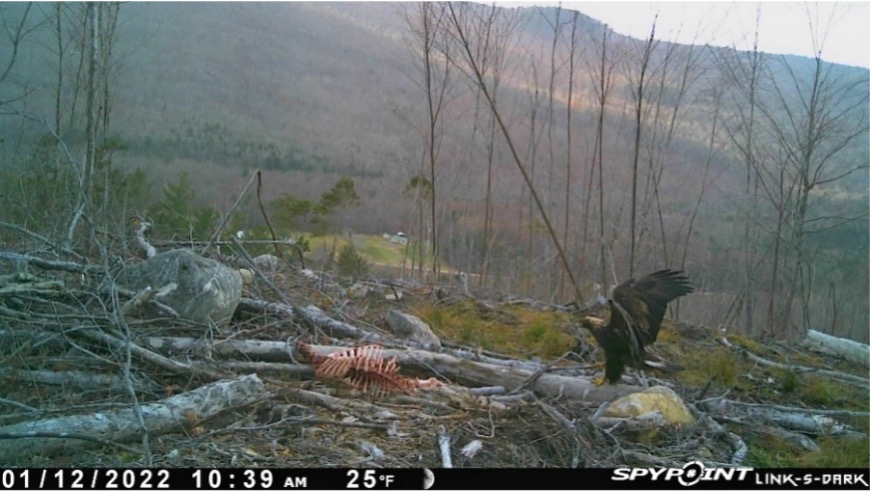
Trail camera photo of a golden eagle at a bait site.
Photo by Albert Ladd
On this page:
- About the Study
- Ways to Participate
- Golden Eagle Identification
- Study Updates
- Additional Resources
- Study Partners and Supporters
About the Study
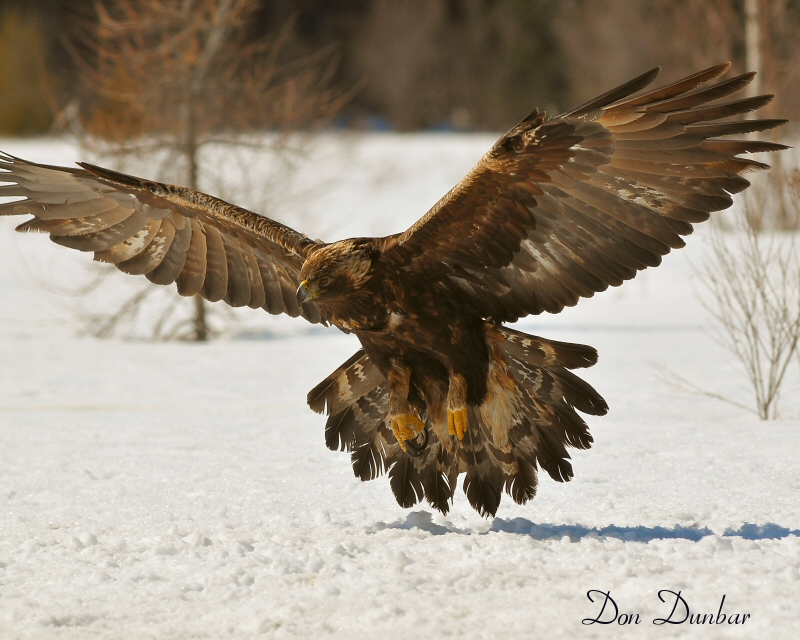
Photo by Don Dunbar
Despite being one of our largest birds in Maine, golden eagles could sometimes be hiding in plain sight. While they share the skies with bald eagles, these birds more often inhabit inland areas, navigating forests and small openings. Because they often resemble immature bald eagles and are naturally secretive, these rare raptors may be easily misidentified or go unnoticed even by people who spend significant time outdoors.
The Maine Golden Eagle Study aims to answer important questions about this population by tracking where these birds travel and the specific habitats they select. Guided by the Maine State Wildlife Action Plan and the priorities of the Eastern Golden Eagle Working Group, this research is part of a larger regional effort to understand this species across its range.
Our work provides a foundation for effective wildlife management, from improving monitoring methods, such as the placement of baited trail cameras, to developing voluntary forest management guidelines for interested landowners. These findings also offer vital guidance for large-scale developments, specifically wind energy projects, to help ensure infrastructure is built in ways that minimize risks to the species.
Building a complete understanding of this bird requires documenting every observation, including where they are not seen. This project is a collaborative effort to improve collective identification skills and strengthen the stewardship of a species that reflects the wild character of Maine. If you are curious about the subtle traits that distinguish these birds in the field, check out our Eagle Identification resources to learn more and test your skills.
Your observations are vital to this research, and there are several ways you can help us better understand this species.
Ways to Participate
- Monitor a Baited Camera Trap
- Provide a Camera Trap Site
- Provide Lead-Free Bait
- Report Observations of Golden Eagles
- Help Spread the Word
Share Photo Observations of Golden Eagles
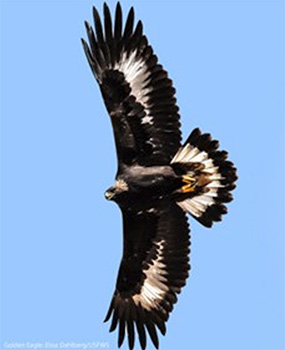
Juvenile golden eagle photo by Elisa Dahlberg
You can make a meaningful contribution to the study simply by keeping an eye out while exploring Maine's outdoors and sharing any photos from your eagle sighting. Whether you spot a golden eagle along a trail or capture one on a trail camera, your photo observations can help us better understand where these birds are.
Before you share a photo with the study, it helps to know exactly what to look for. While both bald and golden eagles live in Maine, golden eagles are often overlooked because they look so much like young bald eagles and are about the same size.
While an adult bald eagle is easy to spot, it takes five years for them to grow their white head and tail feathers. Until then, young bald eagles are very often mistaken for golden eagles. Learning the small details that set them apart will help you spot these elusive raptors and make your reports more accurate.
Identification Resources:
- Maine Eagle Identification
- Golden Eagle Species Page
- Trail Camera Identification Tips
- Cornell All About Birds: Golden Eagle
After you have learned more about eagle identification and have an image you suspect may be a golden eagle, you can share to eBird or by posting in the MAINE Birds Facebook group. After it's confirmed at either site or if you do not use those platforms, please share the image on the Maine Golden Eagle Observation Form.
Set a Baited Trail Camera
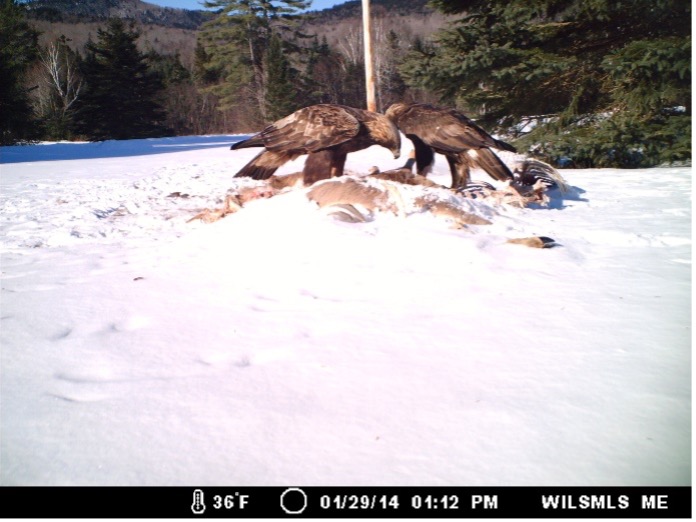
Photo by Chris Martin
Using baited trail cameras is one of the most effective ways to detect golden eagles. Hosting a camera site offers a unique opportunity to contribute directly to research while learning more about the wildlife in your area.
If you already manage a baited camera site—whether for hunting, photography, or personal interest—you're welcome to join the study. Participation will not interfere with your hunting or other outdoor activities. All photos are valuable, whether or not a golden eagle appears, and study staff are available to help review images when needed.
New to trail camera monitoring or interested in collaborating with others? We encourage you to get involved. Before getting started, please review the Quick Start Guide (PDF) in the Maine Golden Eagle Study Trail Camera Protocol info sheet (PDF) to determine whether hosting a site is a good fit. These resources outline how to select a location, set up your station, and manage it in a way that maximizes the value of your contributions.
When you're ready to participate, sign up using the:
Maine Golden Eagle Trail Camera Volunteer Signup Form
What You'll Need
- A trail camera capable of motion-triggered photos every minute, 24/7, with the ability to share images via SD card or online camera access.
- A suitable site that is accessible to you but not frequently disturbed by others—such as a small forest opening, two-track, or inset area within a larger field bordered by mature trees.
- Lead-free bait, such as roadkill deer or trapped beaver (not harvested or dispatched with lead ammunition). Farm animals may be used if free of chemicals and disease
Follow the study guidelines for camera and bait placement to increase your chance of detecting a golden eagle and maximize the value of your photos to the study.
Once your site is active, maintain the bait and camera regularly and share all photos, regardless of whether golden eagles are present. Consistent monitoring and complete photo sets are critical to the success of the study—and your participation makes a real difference.
Provide Bait
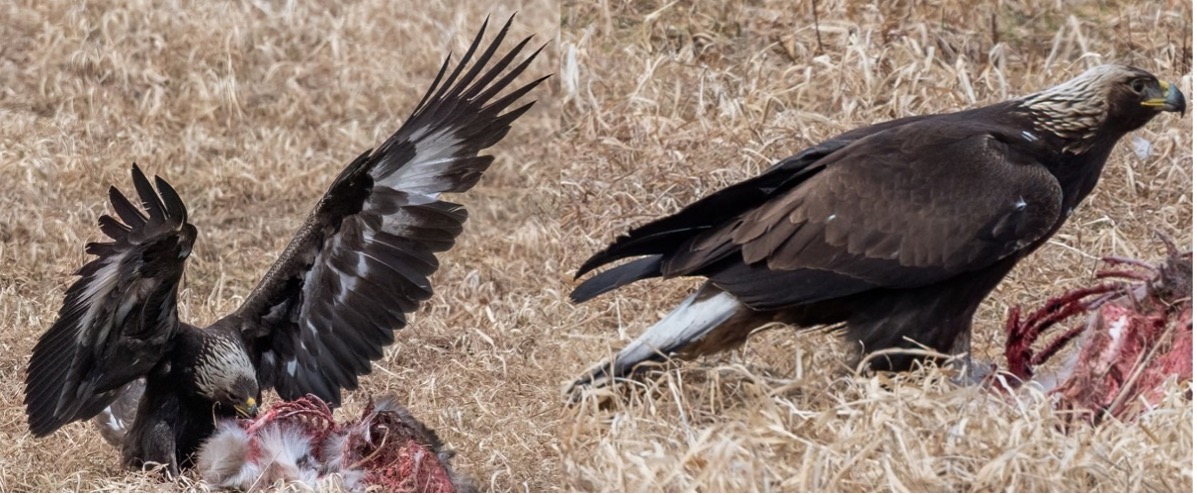
Photo by Laura Zamfirescu
You can support the study by providing bait for trail camera monitoring sites in your area. Supplying bait helps volunteers maintain active sites and increases the likelihood of detecting golden eagles during the winter monitoring season.
While some volunteers operate camera sites during spring or fall migration, the primary focus of this study is December through March. Bait is not needed during the summer months (May through September).
Bait Guidelines
To protect wildlife and ensure the safety of golden eagles and other scavengers, all bait must meet the following criteria:
- Lead-free: Animals should not be harvested or dispatched using lead ammunition. When eagles ingest lead fragments from carcasses, it can cause poisoning and death. (Learn why choosing lead-free ammunition benefits scavenging wildlife such as eagles.)
- Beaver-sized or larger: Do not use animals smaller than a beaver, as they are quickly scavenged and do not persist long enough for effective monitoring.
- No birds: Do not use domestic or wild bird species due to the risk of spreading avian influenza.
- No predators: Avoid coyotes, foxes, or bobcats, as they may deter golden eagles from visiting the site.
- Livestock requirements: Farm animals must be free of medications, barbiturates, and disease.
If you are interested in contributing, please fill out the Maine Golden Eagle Study – Providing Bait Form. If a trail camera volunteer in your area needs bait, we will share your contact information so you can coordinate directly.
Help Spread the Word
The Golden Eagle Study depends on the help from people all across Maine—and every contribution matters. One of the simplest and most effective ways to support this project is to spread the word, because sharing it connects us with more eyes and creates more opportunities to learn about the golden eagles.
Share a link to this page (mefishwildlife.com/goldeneaglestudy) on your social media pages, and/or download and share the project flier:
Golden Eagle Identification
Learning to confidently distinguish Maine's two native eagle species, bald eagles, and golden eagles, is an important first step in contributing to eagle conservation as a community scientist.
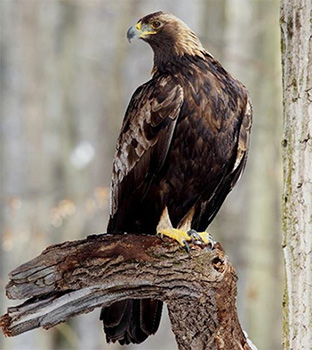
Golden eagle, photo by Randy Flament
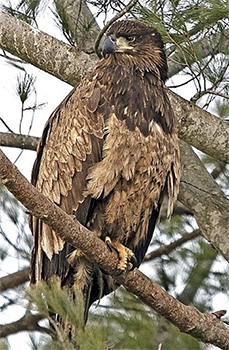
Juvenile bald eagle, photo by Deb Powers
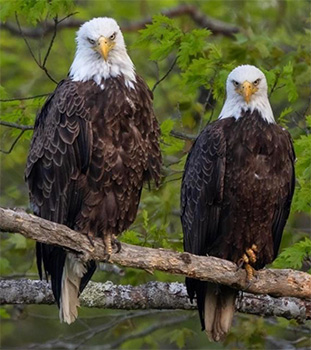
Adult bald eagles, photo by Laura Zamfirescu
You might think that the bright white head of a bald eagle makes this a simple task, but it takes our nation's symbol five years to develop their iconic plumage. For this reason, juvenile bald eagles are often mistakenly identified as golden eagles. Below are a few key similarities and differences to help you become proficient in eagle identification:
- Golden eagles and bald eagles are about the same size. They are approximately 2.5 feet tall with a wingspan of about 6.5 feet, and weigh about ten pounds on average.
- Golden eagles have feathers all the way down to their feet but bald eagles do not.
- Adult golden eagles have amber highlights on their head and neck. Adult bald eagles have a sharply contrasted white head and tail.
- Immature golden eagles have a white tail band and distinct white patches on the bottom side of their wings. Immature bald eagles have mottled white highlights.
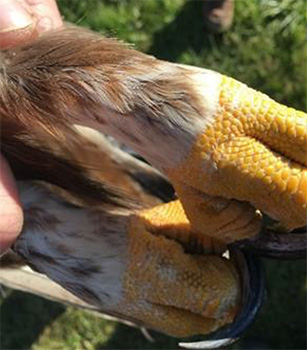
Golden eagle, photo by Tricia Miller
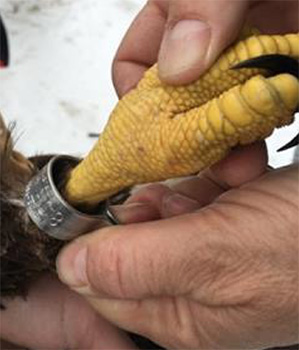
Bald eagle, photo by Tricia Miller
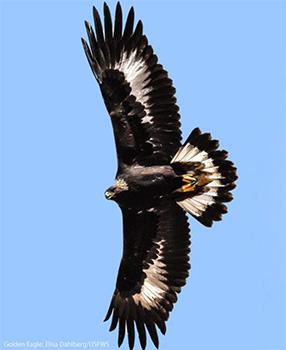
Juvenile golden eagle, photo by Elisa Dahlberg
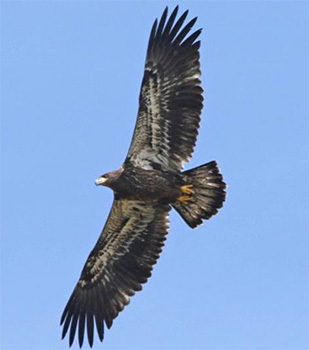
Juvenile bald eagle, photo by Benjamin Hack
Learn more about Maine Eagle Identification (PDF)
The Cornell Lab of Ornithology's All About Birds page is also a fantastic resource.
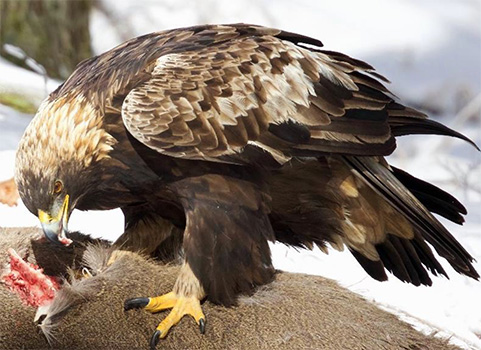
Photo by Randy Flament
Distinguishing similar species in trail camera images is tough because most images will not be perfectly clear like illustrations and photographs in field guides. Key features may not always be visible in the images you capture. If you are going to monitor a camera trap site for this project, it's a good idea to study camera trap images of golden eagles in addition to using a guide. Practicing your identification skills in this context will help you build confidence in identifying golden eagles in various life stages in your own camera trap images.
Study Updates
Fall 2024 Study Update
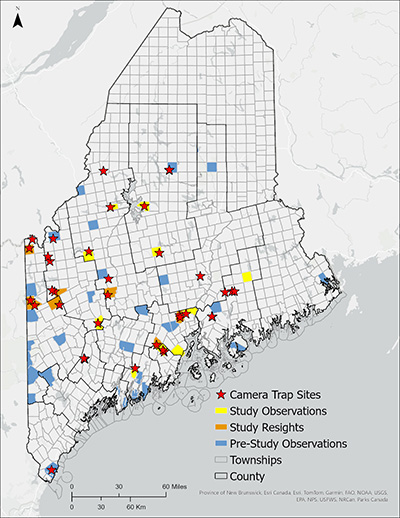
Before the start of the study, golden eagles had been documented in 31 townships across 39 unique sites over the past decade. These sightings represent the baseline, or pre-study, observations.
Since the study began in January 2024, observations have been recorded in 20 townships. Nine of these townships overlap with pre-study observations, while 11 represent new areas where golden eagles were observed for the first time.
Across both pre-study and current study periods, no golden eagle sightings occurred from May through September. This gap is likely due to the limited use or sharing of baited camera trap photos during these months.
Observations from 22 sites within 20 townships documented golden eagle presence on 99 days. The most frequently visited site recorded golden eagle presence for 26 days, followed by another site with 14 days. Five additional sites had golden eagle activity ranging from six to nine days, and the remaining sites ranged from one to three days.
Of the 99 observation days in 2024, 95 were captured via baited trail cameras, three through eBird reports from birders, and one by a camera trapper who photographed a golden eagle flying away by chance with a cell phone. Baited trail cameras have proven highly effective for detecting golden eagles; it's rare to spot them without this method.
Since the study launched, observations confirming golden eagle presence were submitted as follows: 2024 (13 sites), 2023 (6 sites), 2020 (1 site), 2018 (2 sites), 2016 (1 site), and 2015 (1 site).
Approximately 45 camera trap sites submitted photos in 2024, and 13 of these sites documented golden eagle activity.
For study outreach, information has been shared through multiple formats, including email and social media. A presentation on the study was given at the 2024 Raptor Research Foundation conference.
Additional Resources
- Eastern Golden Eagle Working Group
- Conservation Science Global
- Maine Golden Eagle Species Information
- Cornell All About Birds, Golden Eagle
- Making the Switch to Lead-free Ammunition
Study Partners and Supporters
Thanks to everyone who has submitted images to the study, landowners who provided access, and those who assisted in providing bait If you have contributed or supported the Maine Golden Eagle Study and are not listed yet, let us know by emailing erynn.call@maine.gov
- Eastern Golden Eagle Working Group
- Conservation Science Global
- Facebook group MAINE Birds
- US Department of Agriculture Animal and Plant Health Inspection Service Wildlife Services (USDA APHIS WS)
- Maine Department of Transportation
- Hirundo Wildlife Refuge
- Maine Falconry and Raptor Conservancy
- Backyard Wildlife Maine
- Coyote Graphics and Michael Boardman
- Great Pond Mountain Conservation Trust
- Sebasticook Regional Land Trust
- American Forest Management, Inc.