Home → Waste Management → Recycling → Deconstruction
Reducing, Reusing, and Recycling Building Materials
Building demolition and construction waste, referred to as “construction and demolition debris,” “CDD,” or “C&D” makes up approximately 58% of the waste disposed of in Maine, according to a statewide 2026 waste characterization study. CDD includes materials like lumber, steel, drywall and plaster, brick and clay tile, asphalt shingles, concrete, asphalt concrete, wood flooring, cabinets, furniture, and fixtures like bathtubs and sinks. According to the US Environmental Protection Agency, roughly 600 million tons of CDD was generated in the United States in 2018, which is more than twice the amount of generated municipal solid waste. EPA data shows that about 90% of CDD comes from building demolition, while construction scrap makes up around 10 percent.
Many building materials are still in good condition when a building is taken down. It is estimated that more than 75% of CDD from demolitions or renovations could be reused or recycled.
Reusing building materials aligns with Maine’s waste hierarchy and can help offset production (and associated environmental impacts) of sourcing new materials and preserve the history and stories associated with older buildings.
Not all materials are suitable for reuse – for example, lead-based paint or asbestos contaminated-materials - but many wood, metal, stone and ceramic components are easily reusable, as well as doors and windows.
This is where a practice called building deconstruction comes in. Although less common today, deconstruction is not a new thing – in fact, it is what everyone everywhere did until around 1940. Only during the last 80 years have we transitioned to demolishing buildings with heavy equipment. Learn more by watching Maine Green Home and Energy Chat, Advancing the Market for Circular Construction in Maine.
Deconstruction has many benefits, including reducing CDD waste, as well as providing an opportunity for local business development. Because deconstruction can be labor-intensive, it also supports local job growth.
While it is typically more expensive upfront than demolition, deconstruction can be cost-competitive over the lifespan of a project due to reduced waste disposal costs, avoided purchases of new materials, and revenue earned from material sales or potential tax incentives. From an environmental perspective, deconstruction reduces construction and demolition waste, reduces air pollution, reduces carbon dioxide emissions, conserves landfill space, preserves material resources, and saves energy.
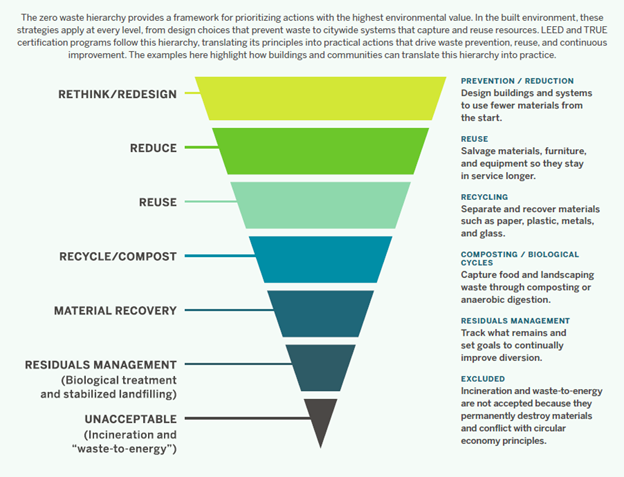
The U.S. Green Building Council’s LEEDv5 standard provides a framework for prioritizing actions with the highest environmental value, applying sustainable materials management strategies from design choices that prevent waste to community systems to capture and reuse resources. LEED and TRUE certification programs follow this hierarchy, translating its principles into practical actions that drive waste prevention, reuse, and continuous improvement. The examples here highlight how buildings and communities can translate a waste hierarchy into practice.
Frequently asked questions
- What is deconstruction?
Deconstruction is sometimes referred to as “unbuilding” because it involves the systematic dismantling of a structure, a process that makes it possible to salvage and reuse building materials. This can involve reusing an entire structure or foundation, recovering specific assemblies and systems, or carefully removing materials or items, for example, flooring, windows, and doors, for reuse.
- What is the difference between deconstruction and demolition?
-
Deconstruction is an environmentally friendly alternative to demolition where buildings or structures are taken apart, allowing materials to be kept unbroken and separated, making it easier to reuse and recycle them. In some cases, entire walls may be removed intact for reuse, a process referred to as creating “post-fabrication” panels.
In contrast, mechanical demolition involves using an excavator to knock down an entire building and any materials within it, smashing all materials and placing them into dumpsters. These loads of material, referred to as “mixed construction and demolition debris” are often sent for processing. Materials such as metal or wood are pulled out for recycling, but the amount of material that can be recovered in a traditional demolition process is much lower than the amount recoverable through deconstruction.
Mechanical demolition allows for quick and efficient removal of a structure. Deconstruction may take longer but maximizes the amount of building material that can be salvaged. Due to the careful nature of dismantling a building, deconstruction provides higher material value by keeping materials intact and separated, making it much easier to reuse or recycle them, thereby minimizing the amount of material going to landfill.
Specialized processing facilities accept loads of mixed/crushed CDD post-demolition and can recover metals and clean wood chips for recycling into new products such as particleboard, in addition to grinding materials for other uses including fuel or for landfill cover and stabilization. See: List of Active Processing Facilities (PDF) in Maine for more information.
- What is Maine doing to support deconstruction and reuse?
-
Maine’s updated climate action plan, Maine Won’t Wait 2024 (pdf) recommends that municipalities support building materials salvage to reduce the amount of waste going to landfills and generate low-cost, low-carbon materials for reuse. Maine’s Community Action Grant program offers funding for communities to develop policies, plans, or programs that align with our state climate plan, such as reuse of building materials.
In addition, Maine’s Solid Waste Diversion Grant program makes competitive funding available for programs, projects, initiatives or activities designed to increase the diversion of solid waste from disposal in the State. Deconstruction and materials reuse align well with Maine’s Solid Waste Management Hierarchy by preventing waste and promoting reuse and recycling of materials.
The Maine Deconstruction Network (MDN) is an informal network of individuals interested in the economic opportunities and environmental benefits of building deconstruction who want to raise awareness and help Maine transition from a linear building economy to a circular one.
For more information, contact Megan Mansfield-Pryor (207) 215-7535.
More (Off Site)1
ReStores by Habitat for Humanity are located around the state and provide an income source for community building projects. ReStores obtain surplus donations from manufacturers as well as donated building materials, fixtures, and antiques.
Second Story Builders a small deconstruction business offering salvaged building materials and deconstruction services in the Midcoast region.
Sustainable Management of Construction and Demolition Materials The US EPA promotes a Sustainable Materials Management (SMM) approach to using salvaged building materials as reused commodities in new building projects, which avoids the need to mine and process virgin materials.
Build Reuse – a national nonprofit dedicated to building materials reuse
C40 Green job opportunities in clean construction - This resource explores how communities can generate green jobs through clean and circular construction practices. This research analyses the number, quality, and types of jobs generated by a transition to clean construction and highlights clean construction policies that can support inclusive workforce development and encourage cleaner construction industries.
Lead-Safe Renovation – EPA guidance for any renovation, repair, or painting (RRP) project in a pre-1978 home that has lead-based paint, which can easily create dangerous lead dust if safety procedures are not followed.
Carbon Leadership Forum - Reclaimed and Reused: Recommended LCA Modeling Guidance to Support EPDs for Reused Construction Materials
The U.S. Green Building Council - Zero Waste Blueprint: How LEED and TRUE Are Closing the Loop on Waste.
1A listing here does not represent an endorsement of a business or organization and is provided for informational purposes only.